This is the latest in Chasing Inspiration, the occasional series where I document the old houses, museums, and salvage finds that keep feeding whatever I end up doing with my own place. This one isn’t American at all — it’s two palaces outside Berlin, from a trip we took two years ago that I’m finally getting around to writing up.
One thing that strikes me every time I travel is how differently Europe treats its past compared to how we’ve treated ours. Here, a Gilded Age mansion could go up and come down again within a decade — plenty of New York’s Fifth Avenue “Millionaire’s Row” houses didn’t even make it a generation before they were leveled for something more profitable. In Germany, a palace built in the 1760s is still standing, still staffed, still being carefully put back together stone by stone when it needs it. That contrast is a lot of why this trip stuck with me.
I love Rococo and Baroque architecture specifically — have for years, long before I started writing this blog — and the two places we visited in Potsdam are about as extreme an example of it as you’ll find anywhere. They’re popular with tourists for obvious reasons, but standing in them is still something else. It’s craftsmanship concentrated to the point of absurdity: gilding on gilding, carved shellwork chasing itself across entire walls, ceilings painted by hand because that was simply what you did. It’s a little much. It’s also one of the great showcases of what humans are capable of when time and money are no object.
The palace and the retreat
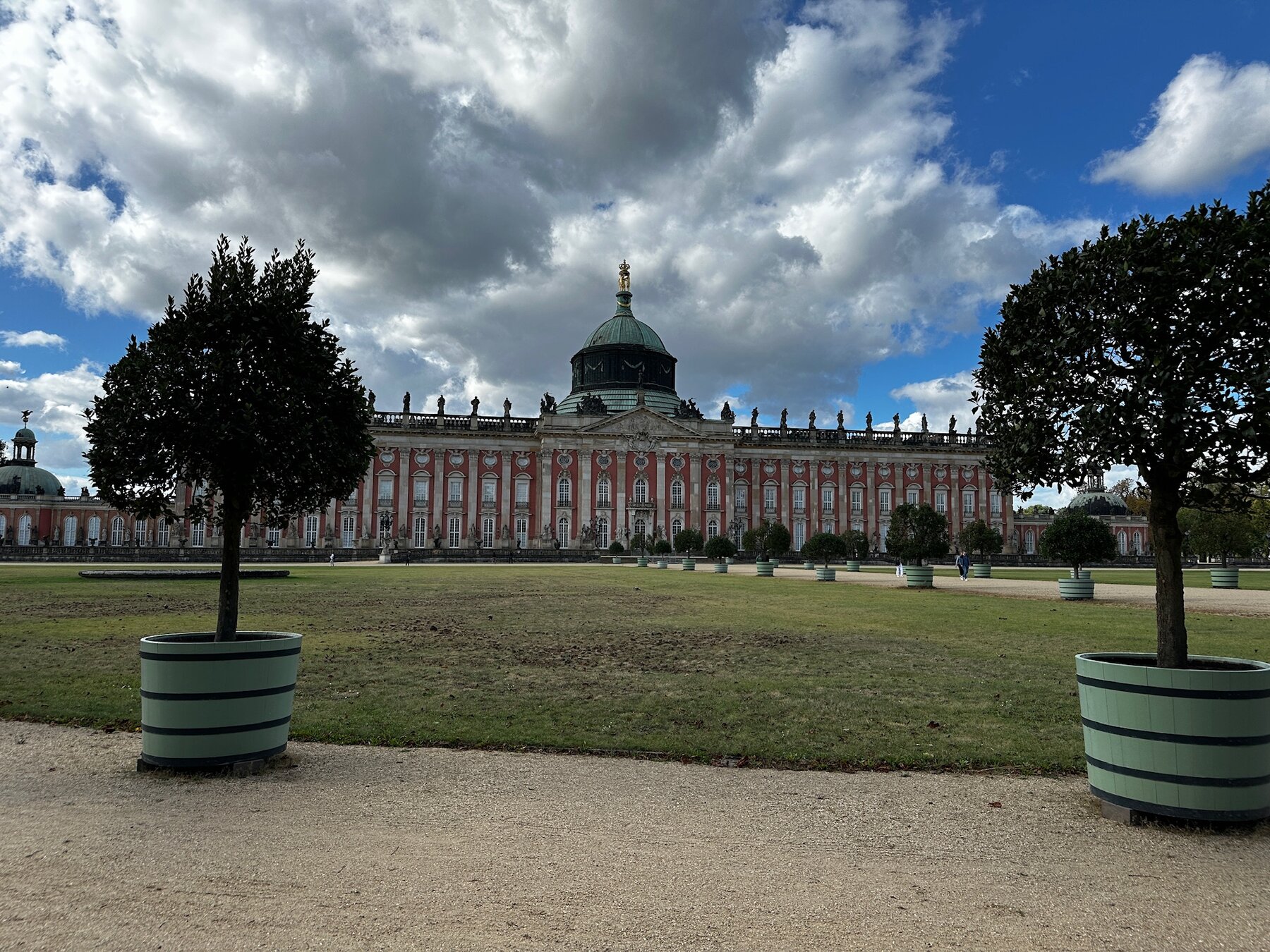
The two buildings we toured are both in Sanssouci Park in Potsdam, about a 30-minute train ride (with a transfer) outside Berlin: the New Palace and Sanssouci Palace itself, Frederick the Great’s original summer retreat.
Sanssouci Palace came first, built between 1745 and 1747 — so it’s pushing 280 years old. Frederick had it built as a genuinely personal getaway, not a seat of power: the name literally means “without worries” in French, and he called it, half-jokingly, his little vineyard house. It was only ever meant to be occupied in the summer, and by design it’s smaller and more intimate than what you’d expect from a king. The New Palace came almost twenty years later, built 1763 to 1769, right after the Seven Years’ War — and it’s the opposite move. Frederick built it big and lavish on purpose, partly as a way of telling Prussia (and everyone else) that the war hadn’t broken them. It’s considered the last great Prussian Baroque palace.
A floor that weighs 90 tons
There’s a room in the New Palace that I couldn’t stop thinking about after the fact: the Marble Hall, directly above the famous Grotto Hall. It’s not the checkered floor you’re picturing from the entry halls — this one is an inlaid marble design with ornate scrollwork banding and a central medallion, closer to what you’d call marquetry in stone than a simple checkerboard. I’d visited this same property once before, back in 2007, and that room wasn’t open then. This time, in 2024, it was — and our historian guide explained exactly why.
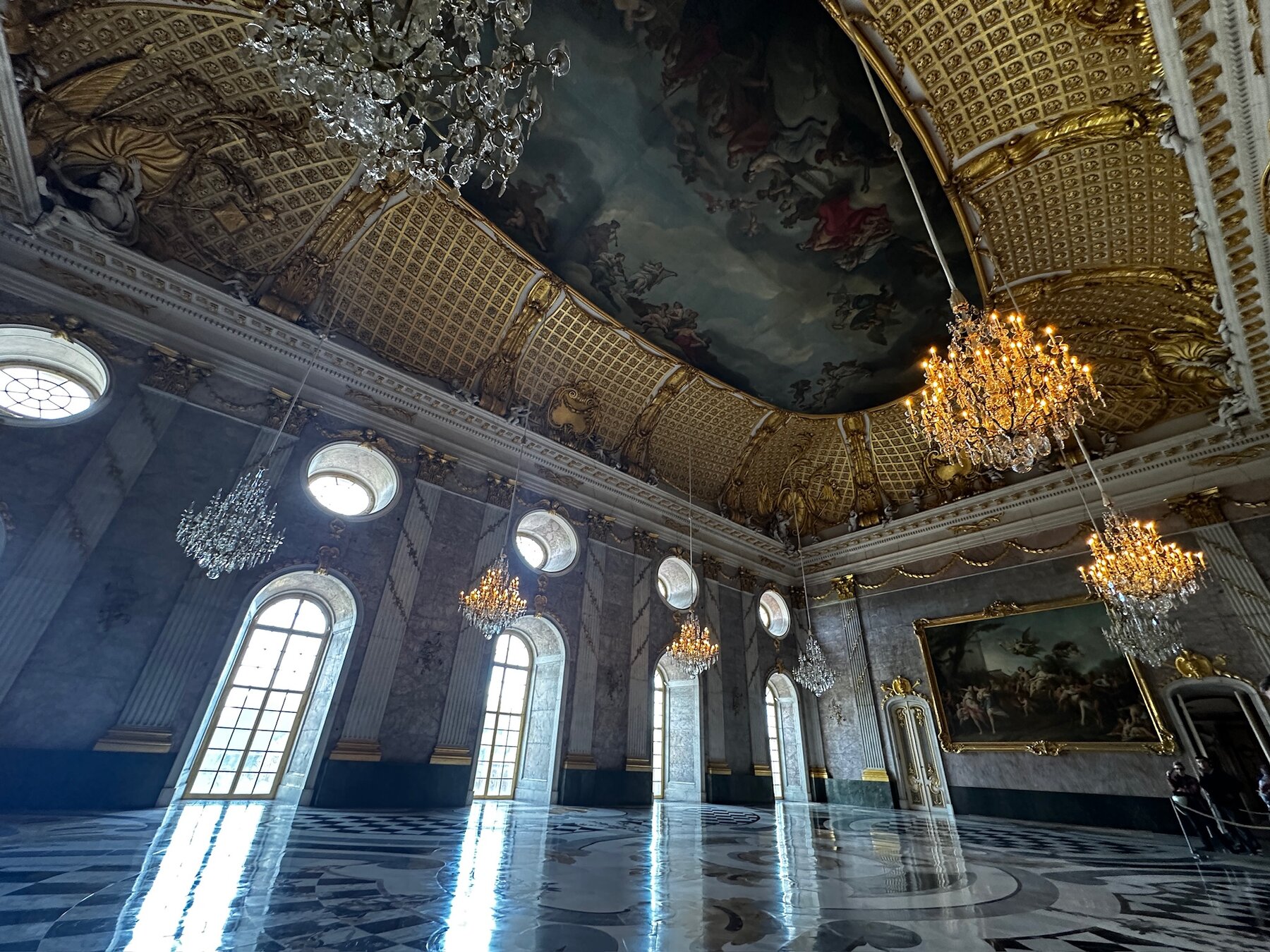
The floor weighs approximately 90 tons, spread across 600 square meters and carried by 128 wooden support beams below. The trouble goes all the way back to how it was built: Frederick was in a hurry to finish the palace as a kind of postwar economic stimulus project, and his architect wanted a fully vaulted brick structure underneath for support. Frederick overruled him for the sake of the look, and the beams that went in were installed with too much moisture in the wood to begin with. Combine that with water getting into the timber during the original stone-laying work, and you’ve got rot working on a structure since 1774 — basically since the year after it was finished.
By the late 2000s it had gotten bad enough that the hall was closed by the local building safety authority — a restorer working on it later described sections of the floor as being “like thin ice on a puddle.” Formal restoration ran from 2013 to 2016, and they had to work with almost no room for error: too much weight or vibration in the wrong place, and you risk the ceiling below. It reopened to the public in April 2016, and now you view it from a suspended walkway around the edge rather than walking on it directly — the floor itself is basically retired from foot traffic entirely. As for the floor level: it sits directly above the ground-floor Grotto Hall, and the hall itself is tall enough that it rises up through what would be a third story — so if it felt like the third floor to you, you weren’t far off.
The structure itself is still an incredible piece of engineering for the amount of hand-craftsmanship layered into it — bands of scrollwork inlaid in dozens of stone types, done by people who had nothing but time to get it right, on a floor they knew would outlast them. It must have been something to watch that come together in real time.
The room that looks like an acid trip
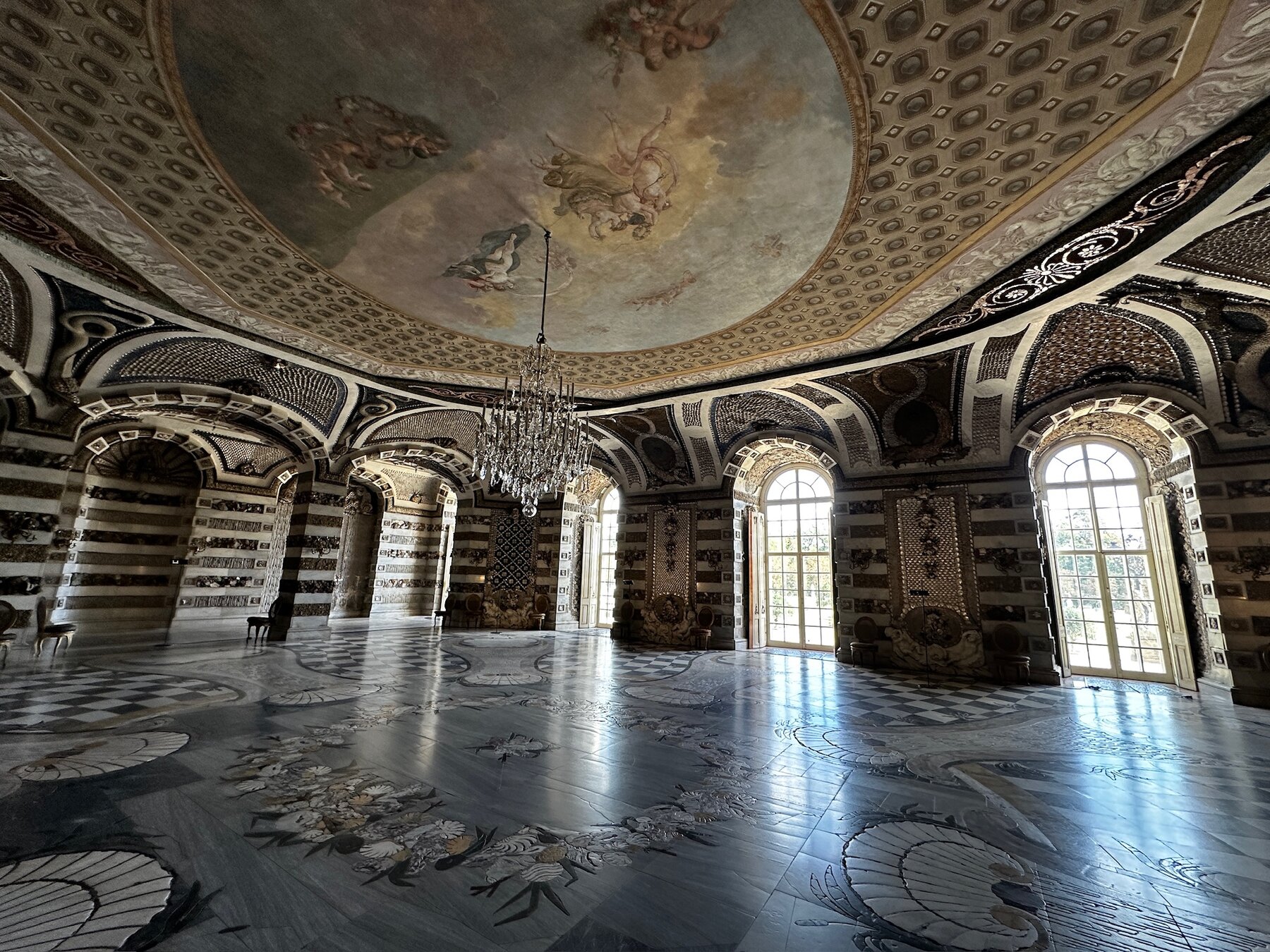
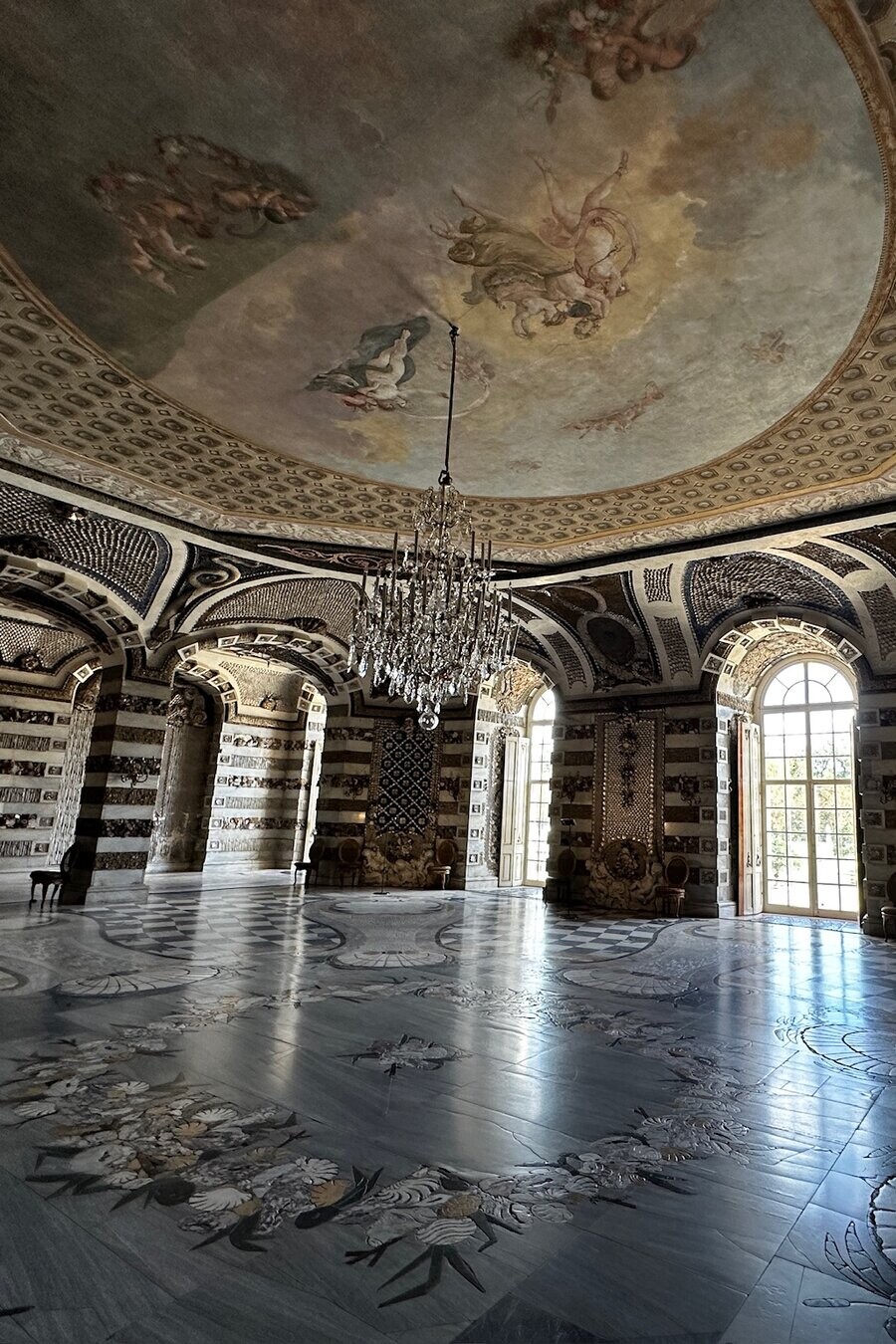
One floor down is the room I actually can’t stop describing to people: the Grotto Hall. Frederick had it built to show off after the war, using minerals from Silesia, and later Kaisers William I and William II kept adding to it — between them they brought in more than 20,000 minerals, precious stones, fossils, shells, and ammonites, all embedded directly into the walls in swirling, almost hallucinogenic patterns. The floor underneath continues the theme with marine-life motifs worked into the marble. It’s whimsical in a way none of the rest of the palace is — genuinely a little wild to stand in. I can’t imagine what it would have been like to attend a ball in that room, candlelight catching on every one of those thousands of shells at once.
Sanssouci, the original
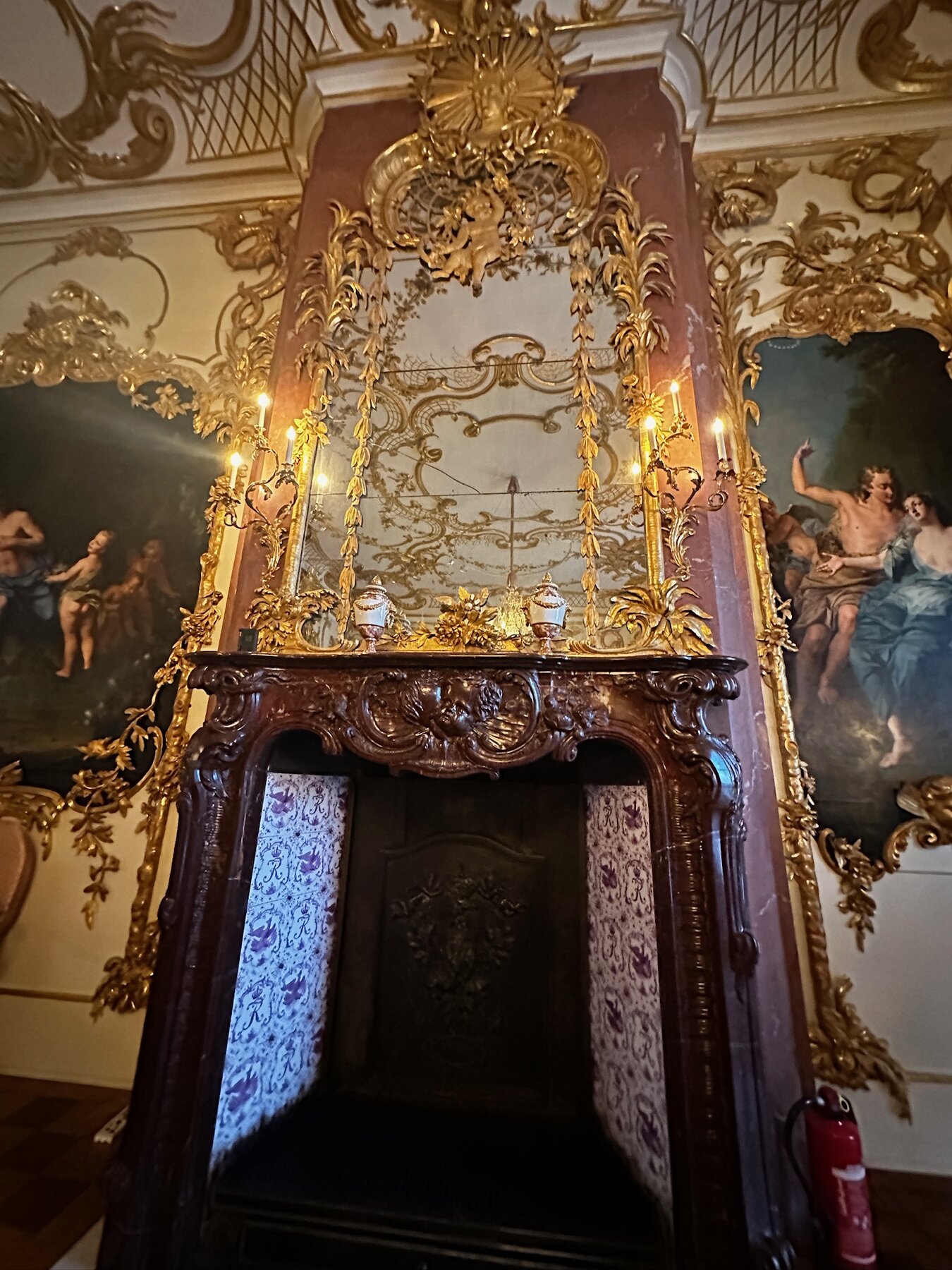
Sanssouci Palace itself is smaller, gentler, and in some ways even more over-the-top in its detailing, because every inch of it was designed around Frederick’s own taste rather than a political statement. The Music Room in particular is where this style is at its most extreme — gilt carving of putti, flowers, and scrollwork crawling up every surface. That carving style even has a name that ties back to the Grotto Hall down the road: it’s called rocaille, French for “shell-work,” and it’s the root of the word “Rococo” itself. The whole aesthetic is named after shells and rockwork, whether or not actual shells show up in the room.
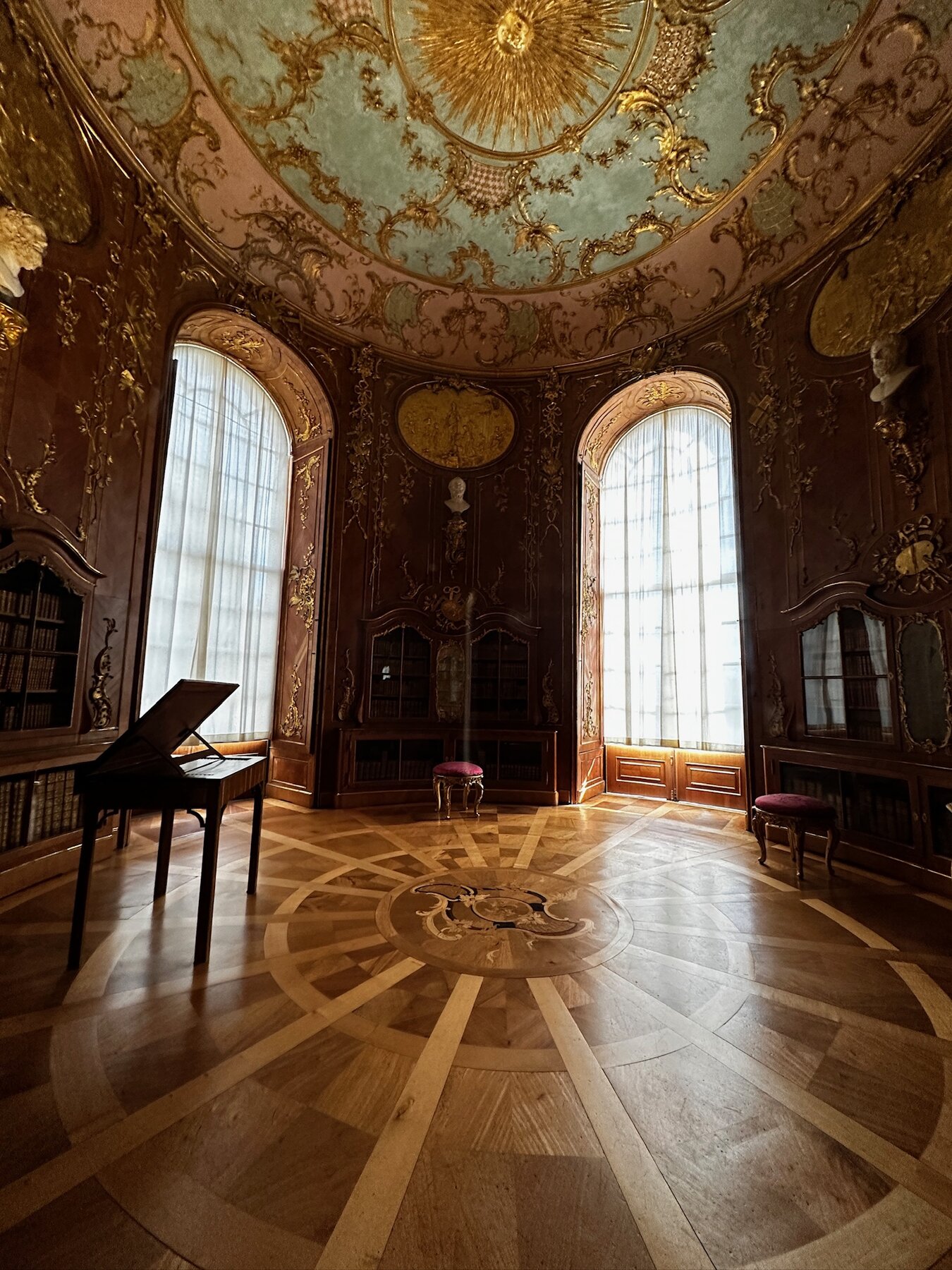
What gets me every time, in places like this, is the irony sitting underneath all of it: this level of craftsmanship — inlaid marble floors, hand-carved gilt scrollwork, ceilings painted by hand — was being achieved a solid century or more before anyone thought to put reliable plumbing into these same houses. Even Versailles, built a hundred years before Sanssouci, was infamous for not having proper bathrooms. People were solving unbelievably hard problems in stone, wood, and gold leaf while just… not solving the plumbing. It’s not lost on us today, and it’s something we still laugh about.
Closing the loop
The personal part of this trip, for me, was Sanssouci Palace itself. I’d been to this same park once before, at 17, and back then the palace was closed. This time, I finally got to walk through it and see the inside — closing a loop that had been open for most of my life. There’s something about getting to finish something you started as a teenager that hits differently than just seeing a new place for the first time.
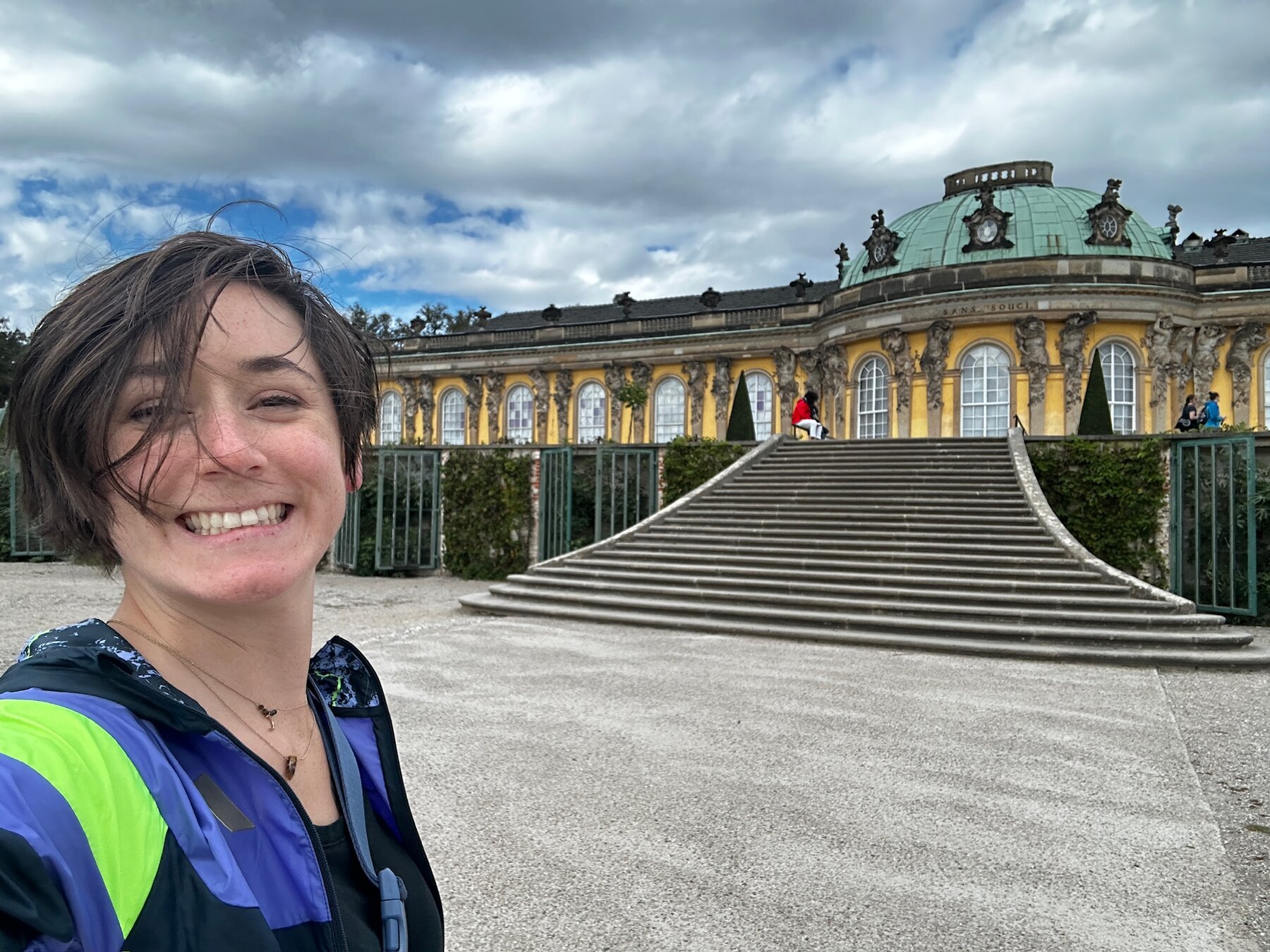
This isn’t a split-level renovation post, and it’s not trying to be. But it’s exactly the kind of place that keeps the someday-house fire burning for me — proof of what’s possible when something is built to be kept, not replaced. More from this trip soon.



Leave a comment