For a long time, I was buying decor the way most people do: one piece at a time, whenever I saw something I liked. A picture frame here, a candle holder there, a vase because it was cute and reasonably priced. None of it was wrong exactly — but none of it was working either, and I couldn’t figure out why my rooms still felt a little flat.
The problem wasn’t taste. It was scale. Looking back at what I’d collected, almost everything I owned was roughly the same size — small to medium, easy to grab, easy to justify. Picture frames, candle holders, vases: a whole shelf of “pretty enough” objects that were all fighting for attention at the exact same visual volume. Nothing anchored anything. Nothing let anything else breathe.
It clicked on a day trip to three stores, not from a single lightbulb moment. I didn’t figure this out sitting at home — I figured it out on a day trip to a few of my favorite stores: Pottery Barn, Crate & Barrel, and Arhaus. I wasn’t there to buy anything specific; I was there to actually study their displays, on purpose, the way you’d study a room you were trying to learn from. And the pattern was everywhere once I looked for it: a few large, confident pieces doing most of the work, with smaller items used sparingly to fill gaps — never the other way around.

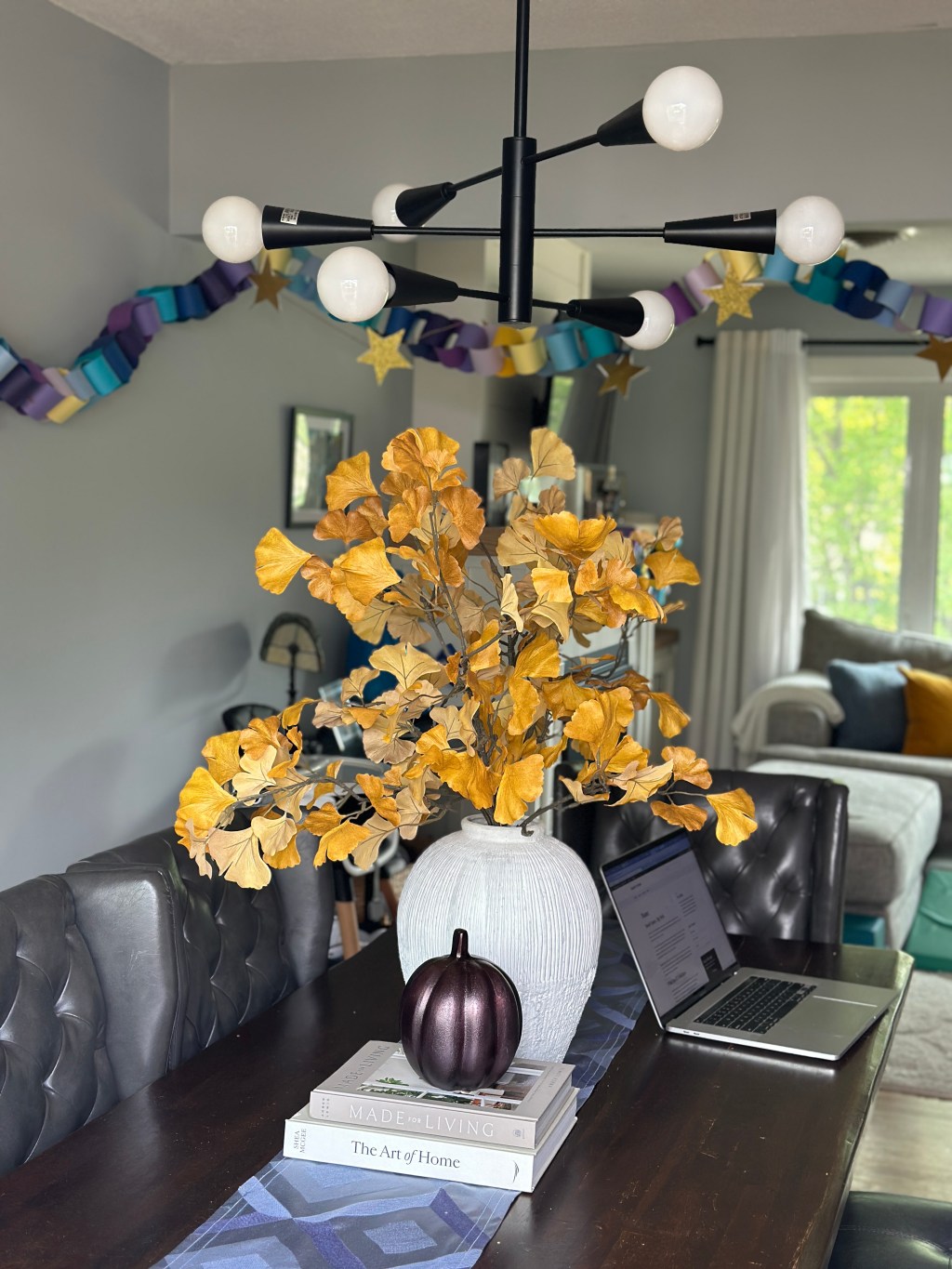
The dining table vase was the moment it became real. My dining table centerpiece, for a long time, was a small, serving-sized bud vase — the kind of size that feels reasonable in a store and disappears the second it’s on an actual table. I didn’t realize it at the time, but that vase was quietly working against me: instead of anchoring the table, it was making the whole space feel smaller, because it was scaled for a shelf, not a room. When I swapped it for a genuinely large vase with tall floral stems, the table — and honestly the whole room — suddenly read as considered. Not “more decorated.” Just bigger-thinking, in the best way. It was the single fastest “this looks designer now” moment I’ve had in this house.
(Photo note: yes, there’s a star garland strung up behind the table in these shots — that’s for my son’s upcoming birthday, not a design choice. Keeping it in on purpose, because this is a real dining room in a house where life is happening, not a staged one. Pay it no mind, or don’t — either way, it’s real.)

Why this trap is so easy to fall into right now. Small, similarly-sized home goods are everywhere and everywhere is competing for your attention — a scroll, an aisle, an algorithm all pushing the next cute little thing. It’s genuinely easy to end up with a house full of items that are all roughly the same modest size, because that’s what’s most available, most affordable one piece at a time, and easiest to say yes to in the moment. Being picky — and specifically, being picky about scale, not just style — is what breaks that pattern.
What I do differently now. Before I buy anything for a surface, I ask what it’s actually going to anchor, and whether it’s big enough to do that job on its own. If the honest answer is “it’ll need four friends the same size to look like anything,” I either size up or I skip it.
Scale is one of those things that’s invisible until you see it, and then you can’t unsee it. If a room feels “fine” but not quite finished, before you buy anything else, look at whether everything in it is secretly the same size.



Leave a Reply